How to Feed the World by Vaclav Smil
I was looking forward to reading this book – and while there were a few captivating chapters and I largely agreed with Vaclav Smil’s conclusion on “what we should do moving forward”, I found most parts of the book quite boring and provided too much unnecessary detail.

Smil’s conclusion - which is not super sexy as he states - is to prioritize two highly effective changes:
- Reduce food waste (which today represents 1/3 of food generated).
- Eat less meat in affluent countries.
YES and YES.
Here are some other points/graphs that I found interesting:
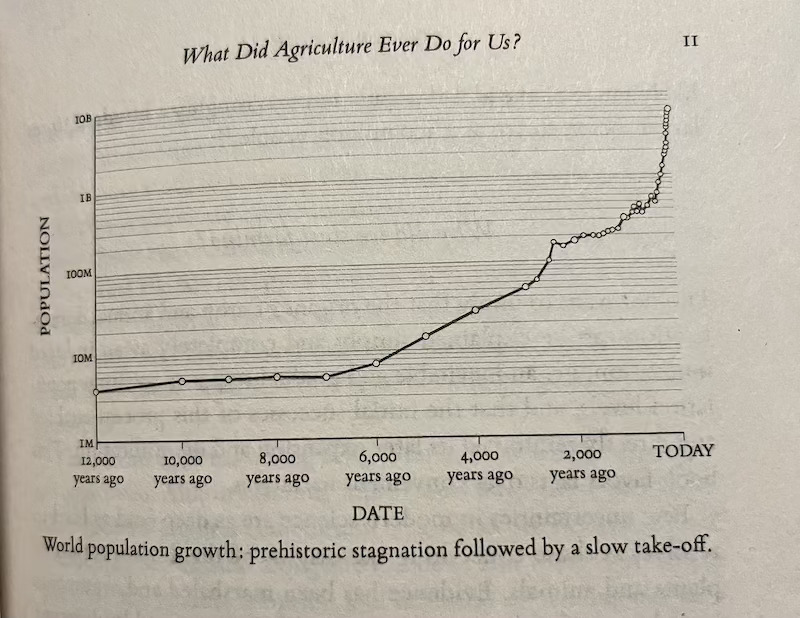
Population growth over time. It’s important to remind ourselves of some key population figures:
- Humans appeared on Earth 300,000 years ago.
- Approx. 100,000 years ago the human population was 100,000.
- 12,000 years ago, the human population grew to 2-4 million. This is also the start of domestication of plants and animals.
- 2,000 years ago, the population grew to 150-300m, and in the 19th century we hit 1 billion.
- Today we are at 8 billion. And the world population is estimated to peak at 10 billion in about 50 years.
We could not achieve this population growth without domestication.
-
Today in the world, there are 1.5 billion cattle, just under 1 billion pigs, and 33 billion chicken! Cattle were initially domesticated for muscle power, and then used as food. However, they are not nearly as energy efficient as pigs and chicken. And of course, they have the highest carbon footprint because of their burp-causing methane emissions. Interestingly enough, beef consumption has gone done over the past 50 years, and chicken consumption has increased significantly.
-
People in China and India were essentially vegetarian 50 years ago. That has changed drastically over the past 20 years.
Ok fine, there were some fascinating parts. And I might go back and refer to some of the data and graphs provided.
So go ahead and check it out - but just be warned that some parts will be better for treating insomnia than maintaining your attention.